
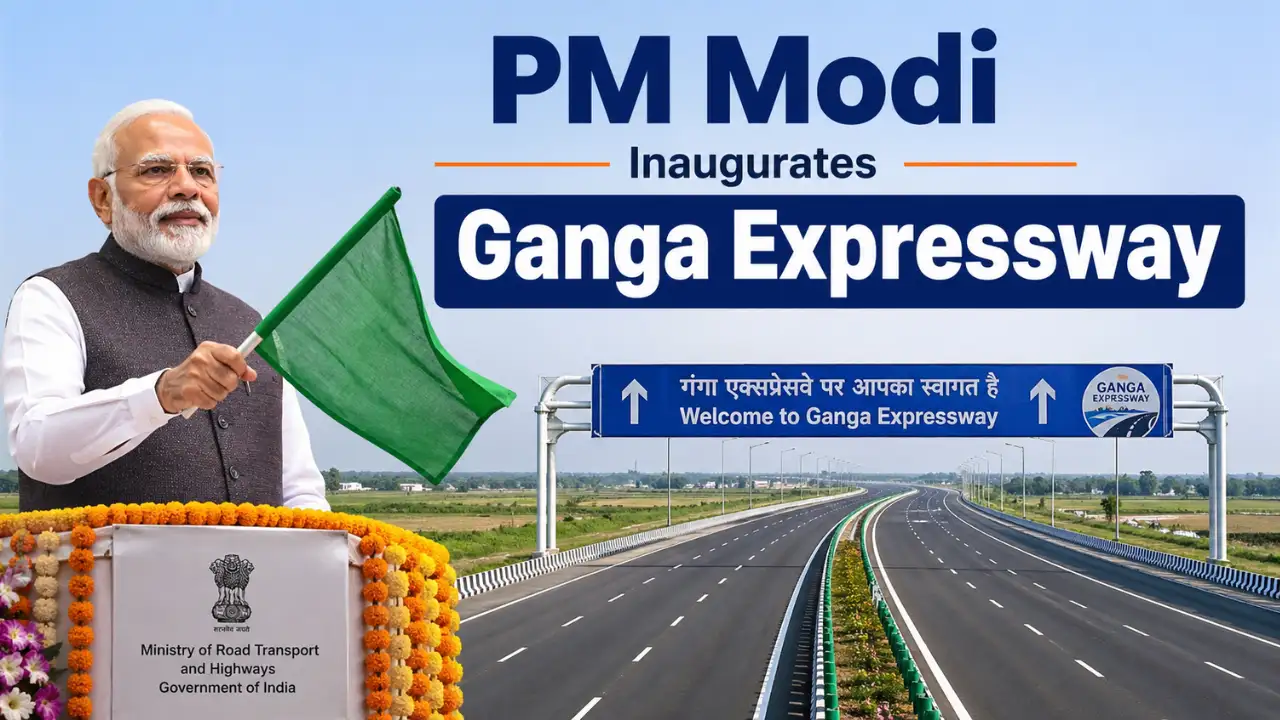
PM Modi inaugurated the Ganga Expressway 594-km on April 29, 2026. What is the Rs 36,230 crore plan linking 12 UP districts
Let’s be honest. A lot of framework inaugurations in India get more reporting than they deserve. Big step, big speech, big numbers, then life goes on pretty much constant for most people. The Ganga Expressway is various. Not because of the ritual in Hardoi on April 29, 2026, but because of what actually got built and how long it really took to get here. PM Modi inaugurated the Ganga Expressway that day, and what was passed above is 594 kilometres of six-lane approach-managed road linking Meerut to Prayagraj over twelve districts of UP. Rs 36,230 cr. 17 yrs from the first suggestion to opening day. That last number possibly tells you more about how the framework works in this country than anything else does.
What Precisely Is the Ganga Expressway?
Districts covered:
- Western UP: Meerut, Bulandshahr, Hapur, Amroha, Sambhal
- Central UP: Badaun, Shahjahanpur, Hardoi
- Eastern UP: Unnao, Raebareli, Pratapgarh, Prayagraj
Six lanes right now, built broad enough to extend to eight later. Sounds like a minor detail. It’s not. Upgrading an operational expressway for additional lanes is the kind of project that costs double, takes forever, and makes everyone’s exchange a nightmare for years. Getting the land and the plan right from the start is just basic common sense, and it’s excellent to see it utilized here.
The Inauguration at Hardoi
Modi’s day began at Kashi Vishwanath Temple before he was directed to Hardoi. Yogi Adityanath was there. UP BJP President Pankaj Choudhary was there. Big event, large public gathering.
Modi’s speech attracted the representative connection between the expressway and the river it follows: “The way Maa Ganga has been a life preserver of UP and this country, the same way, in this era of advanced progress, this expressway passing in the vicinity of Maa Ganga will become a new lifeline for the growth of UP.”
17 Years. That Number Needs Explaining.
Most news coverage of the Ganga Expressway starts the clock at December 2021 when PM Modi laid the foundation stone. Which, fine, but that leaves out the more interesting part of the story.
Mayawati first proposed this road back in 2007. It was called the Greater Noida-Ballia Expressway then. The project went absolutely nowhere. Government changed, the whole thing got shelved, and it sat there for twelve years collecting dust while UP’s roads stayed exactly as they were.
Yogi Adityanath dug it back out in 2019 and actually followed through. Here’s the full timeline:
- 2007: CM Mayawati proposes Greater Noida-Ballia Expressway. Goes nowhere.
- 2019: CM Yogi Adityanath revives the project. Land acquisition kicks off.
- 2020: Rs 2,000 crore allocated for early construction work
- 2021: Land acquisition crosses the 90 percent mark
- Nov 2021: Environmental clearance comes through
- Dec 18, 2021: PM Modi lays the foundation stone
- April 2022: Actual ground-level construction starts
- April 29, 2026: PM Modi inaugurated the Ganga Expressway at Hardoi
Just under three and a half years between foundation stone and opening. For 594 km of greenfield expressway in India, through twelve districts and some seriously complicated land, that’s fast. Genuinely fast. There are flyovers in Indian cities that took longer.
Who Actually Built It?
UPEIDA handled the project through a Public-Private Partnership structure. Two companies did most of the work.
- Adani Road Transport Limited (ARTL): Took on around 464 km, which is close to 80 percent of the total corridor
- IRB Infrastructure: Built the remaining 130 km
Here’s the part that doesn’t get enough attention. These companies didn’t just sign a contract, build the road, and hand it over. They took on the traffic and revenue risk too. That’s their own money on the line if the traffic projections don’t materialise. When a private company does that, it’s a cleaner signal of genuine confidence in the project than any government white paper.
Travel Time. The Most Direct Impact.
Meerut to Prayagraj today, on existing roads, takes somewhere between 10 and 12 hours. Longer if you hit bad traffic, which you usually do. With the Ganga Expressway, that same journey takes roughly 6 hours.
For someone doing that trip once in a while, it’s convenient. For someone doing it regularly, for work or family or pilgrimage, it’s a genuine change in how they live. Half a day is a lot of time to give back to people.
Freight is where the compounding benefits really show up though. A trucking company running goods along this corridor more frequently, with lower fuel costs per trip, sees better margins on every run. Those savings ripple out into the supply chains of every business that moves goods through this part of UP.
On fuel specifically: access-controlled expressways let vehicles maintain steady speeds. No braking for intersections, no crawling through market towns, no stop-start through congested districts. The expressway is projected to cut fuel consumption by around 30 percent on comparable journeys. Across millions of trips a year, that’s not a rounding error in anyone’s accounts.
The IAF Airstrip. Seriously, Why Did Nobody Cover This Properly?
Out of everything written about the Ganga Expressway inauguration, this feature got the least attention and it’s arguably the most interesting thing about the whole project.
A 3.5-km stretch near Shahjahanpur was specifically engineered to function as an Emergency Landing Facility for the Indian Air Force. Not as a theoretical backup. IAF fighter jets and transport aircraft flew actual landing and take-off drills on this strip back in May 2025. It works.
Getting dual-use defence value out of civilian road infrastructure is smart thinking that doesn’t cost proportionally much more to execute at design stage. If the Air Force ever needs an emergency landing option in this region, it exists now. Most coverage gave this one sentence. Whole thing deserved a lot more than that.
AI Cameras. Less Exciting, Still Matters.
The expressway has AI-enabled cameras running along the corridor. Real-time monitoring, early hazard detection, faster alerts before situations escalate into accidents.
Standard CCTV records. These systems are designed to flag problems as they develop. Older UP expressways still rely mainly on physical patrols. That’s a gap in response time that costs lives in accident situations. Better tech here isn’t glamorous but it has a direct impact on the fatality numbers over time.
What Rs 36,230 Crore Actually Gets You
The economic projections attached to this project are the part worth sitting with for a moment.
Projected numbers:
| Metric | Projected Benefit |
| Annual Logistics Savings | Rs 25,000 to Rs 30,000 crore |
| Long-Term GDP Contribution | Over Rs 1 lakh crore |
| Jobs Created | Around 3 lakh over 10 years |
| Villages Connected | 500+ |
| People to Benefit | Over 8 crore |
| Fuel Consumption Reduction | Around 30% |
India’s logistics costs are structurally too high. It’s been a known problem for decades and it directly hurts manufacturing competitiveness. A faster, cheaper freight corridor through the middle of UP doesn’t fix that nationally, but it moves the needle for everything produced, grown, or transported through this part of the country. Even if actual outcomes land at half the projected numbers, the investment math is sound.
What’s going in alongside the road:
11 industrial corridors are being developed across all 12 districts the expressway passes through. Around 2,635 hectares earmarked for manufacturing and logistics hubs. Plans on the table include:
- Pharma parks
- Textile parks
- IT parks
- An industrial city near Meerut’s expressway entrance
- Prayagraj anchoring the eastern end
The road is infrastructure. The industrial development is the actual economic engine. Neither works properly without the other. That connection gets lost sometimes when coverage focuses purely on the road itself.
Eastern UP. This Is The Part That Actually Changes Things.
For most of living memory, eastern and central UP have been carrying a strange contradiction. Large population, decent agricultural output, genuinely hardworking people, but consistently lower incomes and fewer opportunities than the western part of the state. The missing variable, in a lot of cases, was roads.
Raebareli, Pratapgarh, Unnao. These aren’t poor places in terms of what they produce or the number of people willing to work. What they’ve lacked is the road network to convert activity into income. A farmer in Pratapgarh with perishable vegetables has always faced a hard choice between accepting a low local price or watching produce spoil before better markets become reachable.
Better connectivity changes that equation directly. Faster access to Prayagraj, Lucknow, or routes feeding toward Delhi means better prices and less waste. That’s income improvement at the level where it actually matters.
Phase 2. What Happens After This.
What’s planned:
- Meerut to Haridwar (110 km): Goes north from Meerut and connects to the Char Dham Highway at Haridwar. Rs 50 crore pre-construction budget was allocated in February 2025.
- Bulandshahr to Greater Noida (74.3 km): Ties the Ganga Expressway into the Yamuna Expressway at Pari Chowk, which then links to Noida International Airport, the Eastern Peripheral Expressway, and the Delhi-Mumbai corridor.
A single corridor has limited value. A network has compounding value. Phase 2 converts this into a network that pulls in traffic from Haridwar, Delhi, Noida, and the western expressway grid. That changes the commercial and logistics math for the whole thing quite significantly.
Where This Sits In UP’s Broader Road Story
The Agra-Lucknow Expressway is running. Purvanchal Expressway is running. Bundelkhand Expressway is running. The Ganga Expressway fills the remaining gap through the north-central band of the state and connects the western grid to the eastern districts that previously had no equivalent high-speed road access.
Five years ago, UP’s expressway network was patchy. Today it’s starting to look like the kind of infrastructure that Maharashtra or Gujarat had going into their industrial investment boom decades. That matters to any serious investor doing location decisions for manufacturing, warehousing, or logistics operations in India. For more information contact True Asset Consultancy.
FAQs
At what time did PM Modi inaugurated the Ganga Expressway?
April 29, 2026, at a ceremony in Hardoi area, Uttar Pradesh. CM Yogi Adityanath and other senior UP chiefs were present at the case.
What is the total price of the PM Modi inaugurated the Ganga Expressway?
Rs 36,230 crore, created under a Public-Private Partnership framework. Adani Road Transport Limited achieved roughly 80 per cent of the 594-km corridor. IRB Framework handled the continuing portion.
How much does travel time lower amongst Meerut and Prayagraj?
Current tour time is 10 to 12 hrs. The Ganga Expressway lead that down to around 6 hours. That’s a 40 to 50 per cent reduction, which is a real difference both for regular travelers and commercial freight managers.
Which 12 districts does the Ganga Expressway move through?
Meerut, Bulandshahr, Hapur, Amroha, Sambhal, Badaun, Shahjahanpur, Hardoi, Unnao, Raebareli, Pratapgarh, and Prayagraj. One constant corridor across all three areas of UP.
What is the Emergency Landing Facility on the expressway?
A 3.5-km stretch near Shahjahanpur built specifically as an Emergency Landing Facility for the Indian Air Force. IAF fighter jets and transport aircraft ran actual landing and take-off drills there in May 2025. Dual-use defence infrastructure built into a civilian road project at relatively low additional cost.
The Honest Take
Good project. Solid execution. Fast timeline. The IAF landing strip is the kind of quietly clever infrastructure decision that should get more coverage than it does.
But roads don’t develop regions by themselves. The 11 industrial corridors planned alongside this expressway need to actually materialise. Not just on paper, not just in press excuses, but with real factories, real investors, and real jobs that people in Unnao and Raebareli and Pratapgarh can really approach.
The organisation’s savings need to flow down the chain to small conveyors and farmers, not just pool at the best with large freight collector. The tourism boost needs towns along the route to actually be ready for more visitors when they start showing up.
What Rs 36,230 crore bought is the infrastructure that makes all of that possible. The road creates the conditions. What happens in the next two or three years along the industrial corridor is the actual test of whether this investment delivers what it promised.